

Guided by Jewish values, the nonpartisan Jewish Community Relations Council works in common cause with other religious, racial, ethnic, and civic groups to foster a just, democratic, and pluralistic society. The JCRC advocates, educates, collaborates, and mobilizes action on issues important to the Jewish Community and greater community to fight antisemitism and hate in all its forms and promote the security of Israel and Jews everywhere.
“Anyone who can protest against the transgressions of one’s household and does not, is liable for the actions of the members of the household; anyone who can protest against the transgressions of one’s townspeople and does not, is liable for the transgressions of the townspeople; anyone who can protest against the transgressions of the entire world and does not is liable for the transgressions of the entire world.” (Talmud Bavli Shabbat 54b-55a
The Omaha Jewish Community Relations Council’s public policy positions advance the ability of our organization to support our local, regional, and global Jewish community, with a special focus on upholding a healthy, safe, and caring community that is just, equitable, diverse, and inclusive; building bridges with other civic groups; and connecting with Israel and world Jewry. JCRC Omaha’s positions are derived from and aligned with the Jewish Federations of North America and the Conference of Presidents of Major Jewish American Organizations.
JCRC’s Public Policy and Civil Rights Committee advances public policy priority areas based on both the challenges that Jewish communal life faces and opportunities to further strengthen it. In supporting specific legislative and policy vehicles within each area below and in adding compelling legislative priorities, we prioritize issues with a nexus to the JCRC and community we represent, and we strive to be balanced and non-partisan. (These positions were approved by the JFO Board in August 2023)
Since 1856, Jews have lived, worked, and thrived in the State of Nebraska. However, our enduring presence does not guarantee our safety and security. We must be ever vigilant about the rise of antisemitism both in Nebraska and across the globe.
Jewish perspective:
Safety and Security: Jewish tradition teaches about the importance of protecting and cherishing every single life, for all life is holy. From the Mishnah we learn that “One who takes a life, it is as though they have destroyed the entire world. And one who saves a life, it is as if they have saved the entire world.” (Mishnah Sanhedrin 4:5). Each life is an entire world; we must work to safeguard every life using all tools at our disposal including accessing security enhancements for our communities and proactively engaging with our legislature to enact reasonable communal safety legislation.
Combating Anti-Semitism: Avot D’Rabbi Natan teaches: “Who is the strongest of all? One who overcomes his [her/their] inclinations…And some say one who can turn an enemy into a friend.” To combat antisemitism in all of its forms, we must work to build authentic relationships, taking these words to heart and finding common ground.
Support for Israel: The words of renowned poet Yehudah HaLevi remind us “My heart is in the East, and I am in the uttermost West.” Though we live here in Nebraska, for many, a piece of our heart resides in Israel. We look to the words of Israel’s national anthem, to guide us in HaTikvah, the hope, that we will find the ways to create a peaceful world where generations of Jews who come after us will call home. We may all answer the questions of whether Israel is a Jewish State or a State for Jewish People or a state that lives by Jewish values differently, and yet, we all sing the words of HaTikvah and pray for peaceful coexistence with our neighbors:
HaTikvah, by Naphtali Herz Imber: As long as the Jewish spirit is yearning deep in the heart, With eyes turned toward the East, looking toward Zion, Then our hope – the two-thousand-year-old hope – will not be lost: To be a free people in our land, The land of Zion and Jerusalem.
One of the greatest strengths of the Jewish community in Nebraska is its commitment to philanthropic giving to both Jewish and non-Jewish entities. We must continue to ensure that we serve as good stewards to our community and that we advocate to those in positions of power to ensure that public education, health care, and support for those in need are not diminished especially in times of such inequity.
Jewish perspective
Tikkun Olam, which translates to “repairing the world,” is a cornerstone of Jewish ethics and social responsibility. Tikkun Olam compels members of the community to actively participate in bettering the world and elevating the lives of others. And to repair the world, it is best to begin at our own doorstep–within our local community. Maintaining and improving the communal institutions that people rely upon are vital for the holistic betterment of society and thereby embodies the principles of Tikkun Olam.
Omaha is a vibrant, prosperous community but we know that not all residents have equal access to needed services to lead a thriving, healthy life.
Jewish perspective:
The notion that we all have a responsibility to care for the vulnerable among us (represented in our texts as “the poor, the orphan, the stranger, and the widow”) is a common thread woven throughout our sacred texts. Isaiah exhorts us: “Learn to do good. Devote yourselves to justice; Aid the wronged. Uphold the rights of the orphan; Defend the cause of the widow.” (Isaiah 1:17).
Reproductive Rights: Jewish law and thought do not hold a binary, black-and-white view of abortion. While our tradition affirms that a fetus must be respected and cared for as potential life, Jewish law also states that, because a fetus does not become a full “person” until birth, abortion is not only legitimate but required in instances where a pregnancy threatens the life of the mother (Mishnah Ohalot 7:6).
We must work to ensure that Omaha is a welcoming place for all. One way to ensure that is to make sure that we welcome the stranger with open arms. Another way is to always be thinking about our own biases and what we can do to mitigate them. Our community should be a place of inclusivity for all people.
Jewish perspective:
Genesis 1:27 teaches that God creates human beings b’tzelem Elohim, in God’s image, thereby imbuing each person with a touch of the Divine. Every person should be treated with the dignity and respect accorded to God’s creations. We have an obligation to create radically inclusive communities that create space for each person to be their authentic selves. As we advocate for inclusion and equity in our spaces, we remember that we are responsible for one another and that we are commanded to “love your neighbor as yourself” (Lev.19:18). As Rabbi Hillel taught in Pirkei Avot, “If I am not for myself, then who will be for me? If I am only for myself, then who am I? And if not now, when?” (Pirkei Avot 1:4).
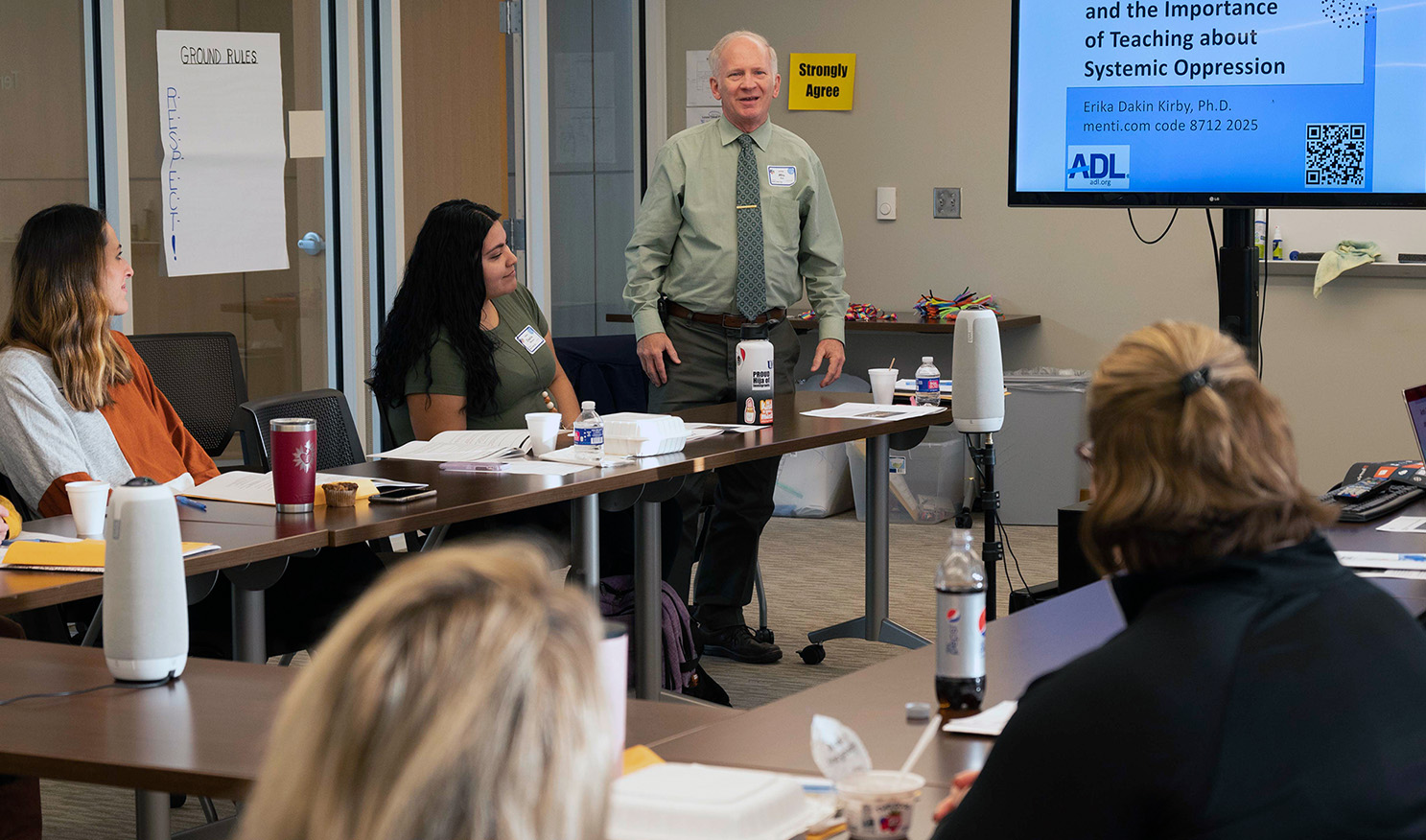
The JCRC welcomes the opportunity to speak to schools, businesses, faith-based institutions, service clubs, and other organizations.
Learn More